|
Insect
Repellents
 Chemical
repellents are the best and perhaps the only suitable
personal protection against outdoor biting insects. Chemical
repellents are the best and perhaps the only suitable
personal protection against outdoor biting insects.
Repellents act by interfering
with the sense organs with which insects locate their
victims.
Most of the commercially available
insect repellents contain diethyl toluamide (DEET), or dimethylphthalate
(DMP).
These preparations come as
lotions, sticks, gels, creams, or in aerosol cans or pump-action
dispensers.
DEET is apparently effective against all free-flying
biting insects.
 DEET is a widely used repellent that deters pests by
making it harder for them to smell humans.
DEET is a widely used repellent that deters pests by
making it harder for them to smell humans.
DEET has been used without harm by millions of people.
However, there have been occasional reports of serious reactions
in a few individuals. Anyone who suspects an adverse reaction
to DEET should stop using it immediately and seek medical
advice.
The chances of an adverse skin reaction are reduced
if DEET is impregnated into clothing rather than applied directly
to the skin.
 When
applied to the skin, DEET remains effective for only a
few hours. However, when impregnated into cotton (not synthetic)
material it remains effective for several weeks. When
applied to the skin, DEET remains effective for only a
few hours. However, when impregnated into cotton (not synthetic)
material it remains effective for several weeks.
When sitting down out of doors, most mosquito bites
occur on the ankles or feet. Cotton ankle bands impregnated
with DEET have been found to give up to 85% reduction in bites
by several species of mosquitos.
Picaridin, a synthetic compound, is also effective
against various pests. It is odorless, less greasy and less
likely to cause skin irritation compared to DEET. However,
its safety has not been as extensively studied as DEET's.
Another option is to wear insect repellent, impregnated
clothes. In this case the repellent Permethrin is used
and is tightly bonded to the fibres of the garment. When insects
are exposed to this repellent their neurons are agitated,
rendering them unable to coordinate voluntary muscles, and
thus unable to attack. Unlike traditional insect repellents,
Insect Repellent Clothing puts the insect repellent on the
clothes you wear, not on your skin.
Permethrin,
a synthetic insecticide, mimics natural extracts from chrysanthemum
flowers. Unlike DEET and picaridin, it is not for direct skin
application but is used on clothing and gear. It can kill
insects on contact.
Traditional repellents usually last for several hours
but with permethrin-based insect repellent clothing, the insect
repellent is IN YOUR CLOTHING, not on your skin and keeps
working as long as you’re wearing the shirt, trousers,
hat or other garment.
Permethrin has been shown to be effective the entire time
the impregnated clothing is worn and is effective in repelling
mosquitoes, ticks, ants, flies, chiggers and
no-see-ums.
Insect
repellents are easily obtained from most pharmacies, supermarkets
etc.
 A
DEET free repellant called TREK plus impregnated bracelets
are available from: A
DEET free repellant called TREK plus impregnated bracelets
are available from: |
Mosquito Nets
In countries where insect-borne diseases are common, a mosquito
net is an important accessory.
 The
use of a mosquito net is strongly recommended wherever
there is any risk of bites from mosquitoes that bite at night. The
use of a mosquito net is strongly recommended wherever
there is any risk of bites from mosquitoes that bite at night.
The Anopheles mosquito that is responsible for spreading
malaria is mostly active from dusk to dawn.
It is well worth buying a
good quality net, because any slippage of the weave would
allow mosquitoes to enter. Any tears should be repaired or
blocked with cotton wool and the net should be tucked in carefully
under the mattress.
 The
net should be checked after getting into bed,
using an electric torch to make sure that no gaps are left.
Care should also be taken not to sleep with any part of the
body touching the net since mosquitoes can feed through nets. The
net should be checked after getting into bed,
using an electric torch to make sure that no gaps are left.
Care should also be taken not to sleep with any part of the
body touching the net since mosquitoes can feed through nets.
Increased security can be
achieved by impregnating the net with permethrin which
is very effective in killing or repelling mosquitoes which
come into contact with it.
Many hotels in the tropics
provide mosquito nets. If in doubt it would be worth taking
your own.
 Another
useful measure is to spray your room (or tent) with an
insecticide aerosol spray after closing the doors and any
windows. This will kill any insects that entered the room
earlier but not any that enter later. For this reason all
doors and windows should be kept closed during the night. Another
useful measure is to spray your room (or tent) with an
insecticide aerosol spray after closing the doors and any
windows. This will kill any insects that entered the room
earlier but not any that enter later. For this reason all
doors and windows should be kept closed during the night.
Mosquito nets are available from numerous outdoor suppliers
or on line from Amazon and from the following:
 |
| |
|
Sun
Screens & Sun Blocks
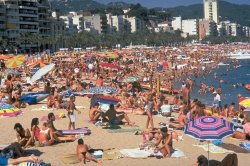 Sunlight
contains Ultra Violet light which can be further categorised
as UVA and UVB. Sunlight
contains Ultra Violet light which can be further categorised
as UVA and UVB.
Exposure
to UVB increases the risk of basal cell carcinoma and
squamous cell carcinoma, two forms of non-melanoma skin cancer.
It is also responsible for sunburn.
Exposure to UVA causes skin ageing and there's a high
level of concern that UVA increases the risk of malignant
melanoma, the most dangerous form of skin cancer. In contrast
to UVB, UVA does not cause sunburn.
Sunscreen sun protection factors (SPF) are measured
by timing how long skin covered with sunscreen takes to burn
compared to uncovered skin. For example, SPF 15 means it will
take 15 times longer to burn when wearing the sunscreen.
 Although
they found that the sunscreen lotions did protect well against
UVB rays, the UVA protection was less than satisfactory. Although
they found that the sunscreen lotions did protect well against
UVB rays, the UVA protection was less than satisfactory.
Because SPF factors only look at burning times, they only
apply to UVB rays.
In
the UK the number of cases of skin cancer
are said to be rising faster each year than for any other
form of cancer. Part of the reason is thought to be due to
our changing lifestyles, for example more people are sunbathing
and taking more holidays in sunnier climates, increasing their
exposure to harmful UV rays.
Part
of the Government's safe sun message advises people to
use protective sunscreen but, according to new research, while
useful for protecting against UVB rays, lotions are less protective
against harmful UVA. What's more, it's possible that people
might be staying out in the sun longer because they think
their skin is being protected, actually increasing their exposure
to UVA.
It
is hoped that future sunscreens will include better protection
against UVA.
 Currently
there are two types of product used for sun protection:- Currently
there are two types of product used for sun protection:-
Absorbents
which work by screening out the sun's rays by a factor which
is displayed on the container. They come in various forms
e.g. lotions, oils, creams, etc.
Reflectants
which are creams usually white and based on zinc oxide which
totally block out the sun by forming a physical barrier.
Both forms can be purchased from a number of outlets e.g.
Pharmacies, sports shops, outdoor equipment suppliers, supermarkets,
etc.
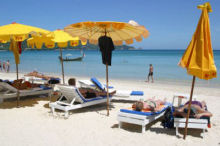
Good sun protection methods include staying in the
shade during the peak sun strength times, covering up, wearing
sunglasses and a wide brimmed hat and using an SPF 15 or higher
sunscreen.
| For
more information on sun screens & sun blocks, go to
the page entitled:- Exposure to the Sun
|
 |
 Water
Purification Water
Purification
When
you travel abroad you should always assume that the water
is unsafe to drink unless you know otherwise. Even in European
hotels and holiday resorts it is a good policy not to drink
the local tap water.
There
are many diseases that can be spread by contaminated drinking
water including typhoid, cholera, hepatitis A, dysentery and
several diarrhoeas.
Nowadays safe drinking water is available world-wide in sealed
plastic bottles but you should always make sure that the seal
is in tact when you receive a bottle. If not, do not accept
it, it could have been refilled from another source.
 In
very remote areas where drinking the local water is the only
option available, some form of purification may be necessary. In
very remote areas where drinking the local water is the only
option available, some form of purification may be necessary.
Water purification entails disinfection and removal of suspended
particles. There are three options available:-
Boiling,
Chlorination/Iodination & Filtration
 Quite
often it is necessary to employ more than one method. When
this is the case always filter water before boiling it and
boil water before treating with iodine, but always wait for
boiled water to cool down before adding the iodine.
Quite
often it is necessary to employ more than one method. When
this is the case always filter water before boiling it and
boil water before treating with iodine, but always wait for
boiled water to cool down before adding the iodine.
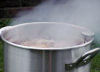
The
simplest and most effective method of water purification is
boiling for five minutes (longer at altitude). When cooled,
the water should be kept in a clean sealable container to
avoid recontamination.
Chemical
purification using iodine or chlorine is another option but
care must be taken not to take too much. Iodine should only
be used for short periods and people with thyroid problems
should consult with their doctor before using it.
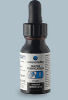 Iodine
is a very effective disinfectant and Iodination is preferable
to chlorination since iodine is effective against waterborne
pathogens, Giardia and other resistant organisms like amoebic
cysts which are resistant to chlorine. It can also be used
to purify water for washing and cooking. Iodine
is a very effective disinfectant and Iodination is preferable
to chlorination since iodine is effective against waterborne
pathogens, Giardia and other resistant organisms like amoebic
cysts which are resistant to chlorine. It can also be used
to purify water for washing and cooking.
It is available as tablets, crystals or tincture (drops).
You should always follow the usage instructions on the container.
After
adding the iodine, allow the water to stand for at least thirty
minutes before drinking.
|
Note
on Iodine
|
|
The
use of iodine for water purification is no longer allowed
under the EU biocide regulations! This is because none
of the current manufacturers have registered the product
under the EU biocide system. It is not due to concerns
about any adverse effects or the efficacy of iodine.
These regulations do not affect the rest of the
world where it remains available.
Pharmacies in the UK & EU can continue to sell non
iodine containing water purification tablets for water
sterilisation. However, Iodine can still be sold for
its other licensed indications.
Iodine is the best method of chemical purification and
is very safe if the guidelines to its use are followed.
|
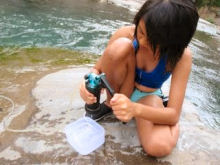 The third method is by filtration which is essential when
the water is turbid or there is a high degree of suspended
matter.
The third method is by filtration which is essential when
the water is turbid or there is a high degree of suspended
matter.
The filter will clarify the turbid water by removing silt,
algae and other suspended matter. Suspended organic particles
also interfere with the process of chemical disinfection.
Units used to filter water should be dependable, easily maintained
and give some indication of when their useful life has expired.
 Filters remove impurities from the water by mechanical straining
and some form of further purification is almost always necessary.
Filters remove impurities from the water by mechanical straining
and some form of further purification is almost always necessary.
This is because filters work by drawing water through a microporous
element such as as a ceramic filter with a pore size of 0.2
microns.
This will remove all pathogenic bacteria, cysts, protozoa
and helminths but not viruses that are much smaller than the
0.2 microns, and since hepatitis A and several forms of diarrhoea
are caused by viruses further treatment is necessary.
Beware of extravagant claims made by manufacturers
as to the effectiveness of water filters without producing
convincing evidence of their claims.
 Remember, the life of a filter is greatly lowered when used
with highly turbid water and the filter should be checked
periodically for cracks and leaks.
Remember, the life of a filter is greatly lowered when used
with highly turbid water and the filter should be checked
periodically for cracks and leaks.
There are several filters available commercially some of which
are quite expensive so you should seek specialist advice before
purchasing one:
 |
 |
N.B.
Drinking water that has been purified by filtration alone
should only be considered if you are happy about the quality
of the source but filtered water should always be boiled or
disinfected before giving to children and babies.
Adventure holidays now make up a large proportion of the
total holidays bought in the UK. Adventure holidays do involve
a certain amount of self sufficiency, even on a totally managed
holiday. Imagine never having to worry about where your water
comes from or buying bottled water again. Some bottled waters
in less developed countries are no more than local tap water
put into branded self-sealing bottles.
If you’re preparing for a trip abroad to a remote destination,
going on an adventure holiday or even just backpacking, then
a travel water filter or purifier bottle should be at the
top of your list of essential packing items.
Relying on bottled water – which is always safe to drink
– presents its own problems, By taking your own re-fillable
bottle with you, you are reducing the environmental impact
of the disposal of sinle use plastic bottles. Every minute,
around one million single-use plastic bottles are purchased
around the world. Many single-use plastic bottles are recyclable.
Unfortunately, most aren’t, and instead end up in landfill
or just duimped as litter where they can take at least 450
years to degrade.
One water filtration bottle could save as much as 700 plastic
bottles from being dumped.
In fact,
there are now places around the world that do not allow you
to use disposable plastic bottles. The Inca trail is one of
them.
Safe Water for International Travelers (SWIT) - is
an independent organization that provides the best available
information about water safety around the world. Information
is gathered from the most important and trustworthy sources.
They haveproduced a list which categorizes the state of the
drinking water in any given country.
 |
|
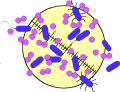 Each
year 10 million international travellers or expatriates,
suffer severe waterborne diseases from ingestion of
contaminated water or food while travelling or staying
abroad. Each
year 10 million international travellers or expatriates,
suffer severe waterborne diseases from ingestion of
contaminated water or food while travelling or staying
abroad.
Worldwide, unsafe water is a major problem. One billion
people do not have access to safe water. It is estimated
that diarrhoeal diseases that result from contaminated
water kill about 2 million children and cause about
900 million episodes of illness each year.
However, international travellers should not become
hysterical about avoiding all water whilst travelling
abroad. Most of the general information sites for travellers
recommend to avoid drinking water anywhere abroad. But
to avoid water where it is safe, could be as annoying,
as it is dangerous to drink it where it is not safe.
Information is now available on the purity of drinking
water worldwide. For a list of all the countries and
the quality of their drinking water:
Click
Here
|
|

 As
well as medical and first aid supplies, there are other
items which are very often required by global travellers.
As
well as medical and first aid supplies, there are other
items which are very often required by global travellers.
