|
|
| |
Tables
of Malaria
Prophylaxis Tablets &
Vaccination Requirements
(Tabs & Jabs)
|
|
|
|
|
| |
|
|
|
|
|
| |
|
|
|
|
|
|
| |
| --- |
|

|
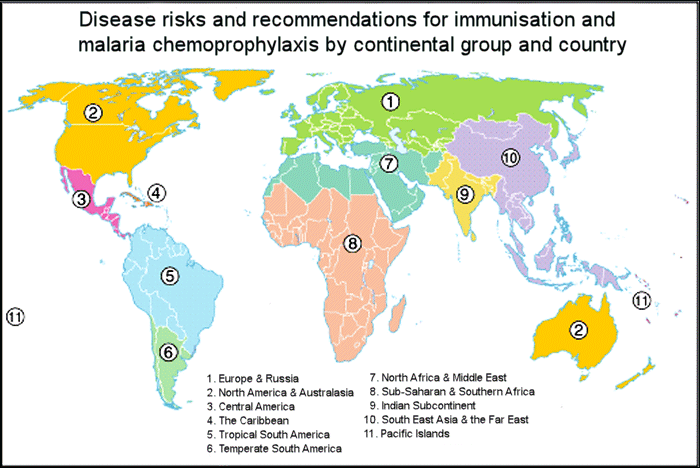
Click
on the required region of the map below for a list of countries
in that region:

|
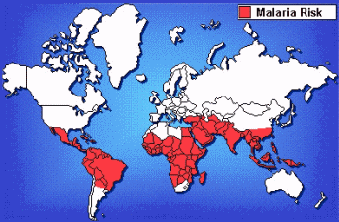
 The
countries in the data tables
are divided into their respective continents. The
countries in the data tables
are divided into their respective continents.
There are six continental tables altogether:
Europe, Africa, Asia & the Middle East, Oceania
(Australasia & Pacific Islands), North America &
the Caribbean, and South & Central America.
Each list of countries is then arranged in alphabetical
order for ease of use.
To access the data, click on the continent
in which the country you require is found on the above
world map and you will be taken to the appropriate page.
The information contained in the tables is regularly
updated using a number of relable reference sources
and is compared and compiled into the alphabetical lists
for each continental group.
The data in the tables only applies to healthy adults
who are not taking any other medications.
The information
supplied is not designed for use by pregnant women,
nursing mothers, children or persons suffering from
epilepsy or any other chronic condition. Those people
should consult with their doctor before taking malaria
tablets.
|
|
Notes
on Malaria Prophylaxis
|
|
Countries
requiring malaria prophylaxis
should be regarded as being at risk all year
round and you should also assume that the whole
country is at risk unless otherwise indicated.
When two or more different regimens appear
together in the same country, they are area specific
and more information about the region can be found
in the text.
Remember:-
No prophylaxis is 100% effective but not taking
anti-malarials where they are indicated will put
you at greater risk should you get the disease.
Remember - Malaria is a killer!
|
|
|
|
|
Travellers
should consult their own doctor or a travel clinic to arrange
to have the relevant vaccinations.
 The
advice on malaria prophylaxis is primarily designed for short
visits (three months or less) to a particular region. The lists
are by no means exhaustive and are for quick reference purposes. The
advice on malaria prophylaxis is primarily designed for short
visits (three months or less) to a particular region. The lists
are by no means exhaustive and are for quick reference purposes.
Where a country is shown as requiring anti-malarial prophylaxis
it should be noted that a specific area may be at risk and not the
whole region.
 Many
urban areas in otherwise malarious zones have little or no risk
e.g. Bangkok city is regarded as a no risk area but is surrounded
by rural areas of high risk. Many
urban areas in otherwise malarious zones have little or no risk
e.g. Bangkok city is regarded as a no risk area but is surrounded
by rural areas of high risk.
There is generally little risk in rural areas above an altitude
of 1500 metres.
 Malarone
is licensed in the UK for malaria prophylaxis and is now recommended
for use in those countries where Doxycycline and Mefloquine are
currently indicated. It is licensed for stays of up to 28 days but
can be used for stays of up to three months. It should be started
one or two days before departure and continued for one week after
return. Malarone
is licensed in the UK for malaria prophylaxis and is now recommended
for use in those countries where Doxycycline and Mefloquine are
currently indicated. It is licensed for stays of up to 28 days but
can be used for stays of up to three months. It should be started
one or two days before departure and continued for one week after
return.
The tables below are reproduced on each of the regional pages
and include a key to the abbreviations used and information on the
different anti-malarial drug regimens.
|
The
information supplied here is derived from a number of
reliable sources and is compared and compiled into the alphabetical
lists found on this web site.
Countries requiring malaria prophylaxis should be regarded
as being at risk all year round and you should also
assume that the whole country is at risk unless otherwise
indicated. The malaria regimen is the recommended
regimen for a country. Use of the incorrect regimen may not
provide adequate cover.
When there are two different regimens for the same
country, they are area specific. Read the text to find out
which regimen is suitable for the area you require.
Where regimen 1 is indicated there is Chloroquine resistance
in that region and it is very likely to be the Falciparum
malaria which is the most serious form of the disease. In
this instance it is vitally important that travellers take
adequate prophylaxis.
Remember:- No prophylaxis is 100% effective
but not taking anti-malarials where they are indicated will
put you at greater risk should you get the disease. Remember
- Malaria is a killer!
|
|
The
Different Drug Regimens
|
| Regimen
1 |
Mefloquine
one 250mg tablet weekly.
OR
Doxycycline one 100mg capsule daily.
OR
Malarone one tablet daily. |
| Regimen
2 |
Chloroquine
300mg
weekly
(2x150mg tablets).
PLUS
Proguanil 200mg daily
(2x100mg tablets). |
| Regimen
3 |
Chloroquine
300mg
weekly
(2x150mg tablets) OR
Proguanil 200mg daily (2x100mg tablets).
|
| Regimen
4 |
No
prophylactic tablets required but anti mosquito measures
should be strictly observed: Avoid mosquito
bites by covering up with clothing such as long sleeves and
long trousers especially after sunset, using insect repellents
on exposed skin and, when necessary, sleeping under a mosquito
net. |
| . |
|
Length
of Prophylaxis
|
| Chloroquine,
Proguanil & Maloprim |
Start
one week before travel, throughout your stay in an endemic
area and continue for four weeks after return. |
| Mefloquine
(Lariam) |
Start
two and a half weeks before travel, throughout your stay
in an endemic area and continue for four weeks after
return. |
| Doxycycline |
Start
two days before travel, throughout your stay in an endemic
area and continue for four weeks after return. |
| Malarone |
Start
two days before travel, throughout your stay in an endemic
area and continue for one week after return. |
|
IMPORTANT!
Take
the tablets absolutely regularly, preferably with or after
a meal.
|
|
Long
Term Use of Anti-Malaria Drugs
|
| Chloroquine |
May
be taken for periods exceeding five years. |
| Paludrine |
May
be taken for periods exceeding five years. |
| Maloprim |
Can
be taken for periods up to one year. |
| Mefloquine |
Can
be taken for periods up to one year. |
| Doxycycline |
Can
be taken for periods up to six months. |
| Malarone |
Can
be used for travel periods up to one year. |
|
Compatibility
of Anti-Malaria Drugs
|
| |
Pregnancy
|
Breast
Feeding
|
Epilepsy
|
Psoriasis
|
Altitude
|
Scuba
Diving
|
| Chloroquine |
OK
|
OK
|
NO
|
NO
|
OK
|
OK
|
| Paludrine |
OK
|
OK
|
OK
|
OK
|
OK
|
OK
|
| Mefloquine
|
OK*
|
NO
|
NO
|
OK
|
NO
|
NO
|
| Doxycycline |
NO
|
NO
|
OK
|
OK
|
OK
|
OK
|
| Malarone |
NO
|
NO
|
OK
|
OK
|
OK
|
OK
|
|
*
These drugs are not suitable during the first trimester of
pregnancy.
|
|
Childrens'
Dosages:
Calculate
the dose by weight rather than by age if possible
|
|
Age/Weight
|
Chloroquine
(once weekly)
|
Proguanil
(once daily)
|
Mefloquine
(once weekly)
|
Doxycycline
(once daily)
|
Malarone
(once daily)
|
|
0
- 12 weeks
under 6kg
|
1/4
tablet
|
1/4
tablet
|
-
|
-
|
-
|
|
3
- 12 months
6 - 10kg
|
1/2
tablet
|
1/2
tablet
|
1/4
tablet
|
-
|
-
|
|
1
- 3 years
10 - 16kg
|
3/4
tablet
|
3/4
tablet
|
1/4
tablet
|
-
|
1
child's
tablet
|
|
4
- 7 years
16 - 25kg
|
1
tablet
|
1
tablet
|
1/2
tablet
|
-
|
1
child's
tablet
|
|
8
- 12 years
25 - 45 Kg
|
11/2
tablets
|
11/2
tablets
|
3/4
tablet
|
-
|
2
child's
tablets
|
|
13
years and over
45kg and over
|
2
tablets
|
2
tablets
|
1
tablet
|
1
capsule
|
1
adult
tablet
|
|
The
above dosages are based upon the guidelines issued by
the Advisory Committee on Malaria Prevention.
|
|
Adult
Dosages
|
|
Regimen
|
Dose
for
Chemoprophylaxis
|
Usual
amount
per tablet (mg)
|
| Areas
without drug resistance: |
|
Chloroquine
Proguanil
|
2 tablets
weekly
2 tablets
daily
|
150mg
(base)
100mg
|
| Areas
of little chloroquine resistance (poorly effective where marked
resistance): |
Chloroquine
plus
Proguanil |
2
tablets weekly
2 tablets daily |
150mg
(base)
100mg |
| Areas
of chloroquine resistant P. falciparum: |
|
Mefloquine
Doxycycline
Malarone
(atovaquone & proguanil)
|
1 tablet
weekly
1 tablet/capsule
daily
1 tablet
daily
|
250mg
(228 in USA)
100mg
250mg
atovaquone &
100mg proguanil
|
 |
 |
 |
| |
|
|
 |
| |
|
 Health
Information for Overseas Travel was first issued in 1995
as a companion volume to the well established UK Health Departments'
memorandum Immunisation against Infectious Disease (the 'Green
Book'). It was well received, especially by doctors and practice
nurses giving travel health advice in primary care, and is
now commonly referred to as the UK 'Yellow Book'. Health
Information for Overseas Travel was first issued in 1995
as a companion volume to the well established UK Health Departments'
memorandum Immunisation against Infectious Disease (the 'Green
Book'). It was well received, especially by doctors and practice
nurses giving travel health advice in primary care, and is
now commonly referred to as the UK 'Yellow Book'.
Since
that first edition, there has been a major increase in the
amount of travelrelated information available both to
health professionals and travellers, in books, the media and
via the Internet. The origins and significance of the information
are not always clear, however, and the advice may not be consistent
with that usually given in the UK.
The aim
of this book is therefore still relevant: to provide a concise
and authoritative onestop source of information about
the common health risks to travellers and how to reduce them.
It is not a statement of Government policy. It is advisory
rather than prescriptive, emphasising the need to assess the
risks for the individual traveller, while recognising the
limitations of the data on which such assessments sometimes
have to be made. Risk behaviours are also discussed, and emphasis
put on measures travellers themselves can take to protect
their health abroad.
The following table refers to chapters within the Yellow Book
and provides further information about immunisation and malaria
prophylaxis:
|
| |
|
|
| |
While
the recommendations for each continental group above are about
immunisations and malaria chemoprophylaxis, it must be remembered
that most health problems affecting travellers are not vaccine
preventable.
Advice about accident and injury prevention, food and water
hygiene, protection against insect bites and sexual health may
be equally important. These subjects are dealt with in the succeeding
chapters:- |
| |
|
|
| |
|
| Note:
The On Line version of the Yellow Book was archived in December
2013 but is still a good source of travel health information. |
|
| Copyright
© 2002 -
Traveldoctor.co.uk. All rights reserved. |
|